Core Idea
Shift Toward Innovation and Traditional Pharmaceuticals, With Significant Room for General Fund Allocation
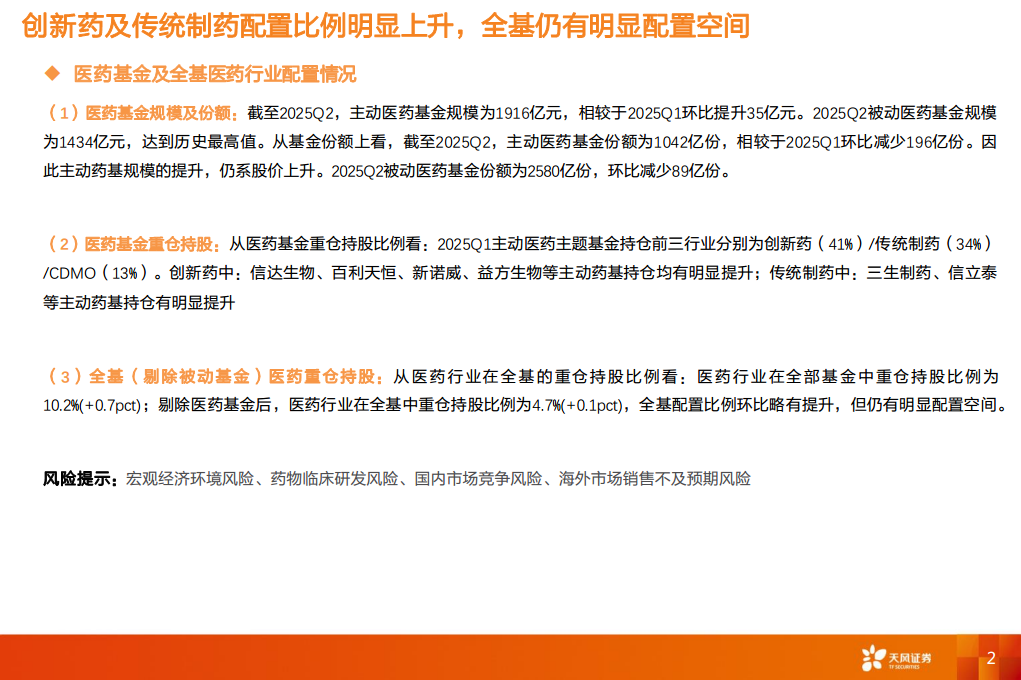
The 2025Q2 analysis of pharmaceutical fund holdings reveals a pronounced shift in allocation toward innovation-driven and traditional pharmaceutical sectors, driven by robust price appreciation and strategic portfolio rebalancing. Active pharmaceutical funds experienced a modest increase in scale, reaching 1,916 billion RMB, despite a substantial decline in fund shares, indicating that the growth was predominantly attributable to rising stock prices rather than net capital inflows. Passive pharmaceutical funds hit an all-time high in scale at 1,434 billion RMB, underscoring sustained passive investor interest in the sector. Among active pharmaceutical funds, innovation drugs (41%) and traditional pharmaceuticals (34%) dominated the top holdings, with notable increases in positions for companies such as Innovent Biologics, Brii Biosciences, and CSPC Pharmaceutical Group. In contrast, general funds (excluding pharmaceutical funds) maintained a relatively low allocation to healthcare, with a 4.7% overweight ratio, up only 0.1 percentage points quarter-over-quarter, suggesting ample room for future incremental allocation. This divergence underscores a market environment where specialized pharmaceutical funds are aggressively pivoting toward high-growth sub-sectors, while broader market participants remain cautious, leaving significant upside potential for further institutional rotation into healthcare.
Underweight Positions in Medical Equipment and Traditional Chinese Medicine Highlight Structural Imbalances
Despite the upward trend in innovation and traditional drug allocations, the analysis reveals persistent underweight positions in several key sub-sectors. Active pharmaceutical funds showed substantial underweight in traditional Chinese medicine (-7.4%), medical equipment (-4.1%), and medical consumables (-3.7%), indicating that the current market focus is narrowly concentrated on select high-innovation areas. Interestingly, while innovation drugs and traditional pharmaceuticals are heavily overweight, CDMO (Contract Development and Manufacturing Organization) witnessed a slight reduction in overweight from 9.2% in Q1 to 5.2% in Q2, suggesting that the earlier aggressive positioning in CDMO may be moderating. This structural imbalance suggests that while the core thesis of innovation-driven growth remains intact, there is potential for a broader sector rotation as value-oriented sub-sectors become relatively attractively priced. The data implies that the pharmaceutical market is experiencing a bifurcation, with capital flowing toward visible near-term catalysts (innovation and traditional pharmaceuticals) while avoiding areas with uncertain regulatory or competitive dynamics.
Main Content
Pharmaceutical Fund Scale and Share Dynamics: Price-Driven Growth Amid Share Contraction
Active and Passive Fund Scale Trends
As of 2025Q2, the total scale of active pharmaceutical funds stood at 1,916 billion RMB, a sequential increase of 35 billion RMB from Q1 2025. This growth occurred despite a 196 billion share decrease to 1,042 billion shares, confirming that the scale expansion was purely price-induced. Historically, active pharmaceutical fund scale peaked at 2,700.8 billion RMB in Q4 2021, and the current level remains well below that peak. In contrast, passive pharmaceutical funds reached a record high of 1,434 billion RMB in Q2 2025, with shares declining only marginally by 89 billion to 2,580 billion shares. The divergence between active and passive fund scale behavior suggests that while active fund managers are more selectively rotating holdings, passive vehicles continue to attract capital through price appreciation, reflecting strong underlying sector momentum.
Fund Share Dynamics
The steady decline in active pharmaceutical fund shares since early 2023 (from around 1,400 billion shares in Q4 2022 to 1,042 billion in Q2 2025) indicates a persistent net outflow from actively managed pharmaceutical funds, likely driven by investor redemptions and profit-taking. However, the concurrent price gains have more than offset these outflows, demonstrating the powerful impact of stock price appreciation on fund scale. This pattern is consistent with a market where investors are skeptical of sustained upside but stock performance remains strong, creating a dilemma for fund managers. The passive fund share trend, while also declining slightly, has been more resilient, suggesting that passive strategies are gaining favor as investors seek lower-cost exposure to the pharmaceutical sector.
Top Holdings and Sub-Sector Allocation Shift: Innovation and Traditional Drugs Dominate Active Fund Portfolios
Active Pharmaceutical Fund Top Ten Holdings (2022Q2-2025Q2)
The holdings composition of active pharmaceutical funds reveals a clear rotation toward innovation and traditional pharmaceuticals over the past year. As of Q2 2025, innovation drugs accounted for 41% of total holdings, up from 34% in Q1 2025, while traditional pharmaceuticals rose to 34% from 26% in Q1. In contrast, CDMO exposure declined to 13% from 17% in Q1, and all other sub-sectors (medical consumables, CRO, Chinese traditional medicine, medical equipment, etc.) represented less than 3% each. This concentrated allocation underscores the sector's current preference for companies with visible near-term catalysts, particularly those in the innovative drug pipeline and established traditional pharma with strong earnings visibility. The shift appears to be driven by favorable clinical trial results, regulatory approvals, and strong product sales momentum in these segments.
Key Holdings by Sub-Sector
Within innovation drugs, the top holdings by market value as of Q2 2025 included Innovent Biologics (61.20 billion RMB, 5.6% of active fund holdings), Brii Biosciences (53.93 billion, 4.9%), Zelgen Biopharmaceuticals (50.62 billion, 4.6%), BeiGene (49.80 billion, 4.6%), and Kelun-Biotech (43.40 billion, 4.0%). Notable quarter-over-quarter increases were seen in Innovent Biologics (+24.54 billion), Brii Biosciences (+20.42 billion), and XNW (Xinnowe, +19.01 billion). Among traditional pharmaceuticals, Hengrui Medicine remained the largest holding at 97.09 billion (8.9%), although its value decreased by 10.80 billion. Sanofi (San Sheng) and Xintai (Xinlitai) saw significant increases of 36.75 billion and 32.92 billion, respectively, reflecting rising fund interest in these traditional players. The data indicates that fund managers are not only favoring large-cap innovation but also rotating capital into select traditional pharma companies with promising product portfolios and pipeline upgrades.
Overweight and Underweight Analysis: Innovation Drugs and Traditional Pharma Surge, Medical Equipment and TCM Lag
Sub-Sector Overweight Percentage (2023Q4-2025Q2)
The overweight percentage (active fund holdings relative to benchmark weight) for innovation drugs rose sharply from 17.5% in Q1 to 20.6% in Q2, a new high. Traditional pharmaceuticals also saw a substantial increase from 2.9% to 9.4%, indicating that these two sub-sectors are now significantly overweight relative to their benchmark representation. In contrast, CDMO overweight declined from 9.2% to 5.2%, suggesting a moderation of earlier enthusiasm. Other sub-sectors such as CRO remained slightly overweight at 0.7%, while medical equipment became more underweight at -4.1% (from -3.2% in Q1), and traditional Chinese medicine deepened its underweight to -7.4% (from -6.2% in Q1). The underweight positions in medical consumables (-3.7%) and medical services (-2.5%) also widened. This pattern reflects a market that has become increasingly bipolar, with capital flowing aggressively into innovation and traditional pharma while avoiding areas perceived as cyclical, regulatory-risk-heavy, or lacking near-term catalysts.
Implications for Sector Rotation
The data suggests that the pharmaceutical market is undergoing a significant structural shift. The persistent underweight in TCM and medical equipment may present opportunities for bargain hunters if these sectors show signs of recovery or policy support. However, the current momentum remains firmly with innovation and traditional pharmaceuticals. The sharp increase in traditional pharma overweight, from near zero in Q4 2023 to 9.4% now, indicates that fund managers are embracing traditional companies that are successfully transitioning to innovation or benefiting from favorable pricing dynamics. The reallocation away from CDMO suggests that the earlier premium placed on contract manufacturing may be fading as supply-chain concerns ease and competition rises.
General Fund Allocation: Still Under-allocated Despite Slight Improvement
Healthcare Weight in All Funds vs. Ex-Pharma Funds
As of Q2 2025, the healthcare sector accounted for 10.2% of total fund heavy holdings, an increase of 0.7 percentage points from Q1. However, when excluding dedicated pharmaceutical funds, the healthcare weight dropped to only 4.7%, a modest increase of 0.1 percentage points. This wide gap (10.2% vs 4.7%) confirms that the majority of healthcare exposure is concentrated in specialized funds, while general funds remain significantly underweight. The historical trend shows that the ex-pharma fund healthcare weight has fluctuated between 4.1% and 6.5% over the past four years, and the current level is near the lower end of this range. This implies significant potential for general fund inflows if broader market sentiment turns favorable toward healthcare. The Q2 uptick, albeit slight, suggests that some general fund managers are beginning to nibble, but the overall allocation remains conservative.
Potential Upside
Given that the healthcare sector's weight in the broader market (represented by the CSI 300 or similar) is substantially higher than 4.7%, there is room for general funds to increase their healthcare allocation by at least 2-3 percentage points without becoming overweight. Such a move could provide a significant catalyst for the sector, especially if innovation drug pipelines continue to deliver positive results and traditional pharma earnings stabilize. The report highlights that the current low allocation is a key structural factor supporting the thesis that the pharmaceutical sector has room to run, subject to macroeconomic and regulatory stability.
Conclusion
The 2025Q2 analysis of pharmaceutical fund holdings paints a picture of a market undergoing a pronounced rotation toward innovation and traditional pharmaceuticals, driven by stock price appreciation and strategic fund positioning. Active pharmaceutical funds grew in scale despite share outflows, confirming that price gains are the primary driver. The heavy concentration in innovation drugs (41%) and traditional pharmaceuticals (34%) underscores a focused investment theme, while underweights in medical equipment, traditional Chinese medicine, and other sub-sectors suggest significant divergence. Meanwhile, general funds remain under-allocated to healthcare, with the ex-pharma fund healthcare weight at just 4.7%, indicating ample room for future capital inflows. The key risks outlined—macroeconomic volatility, clinical development failures, domestic competition, and overseas market challenges—remain pertinent, but current structural dynamics suggest that the pharmaceutical sector continues to offer attractive opportunities for specialized and general fund investors alike. The data supports a cautious but constructive view, with the strongest conviction in innovation-driven companies and select traditional pharma firms that are effectively executing their pipeline strategies.





 微信扫一扫-立即使用